Posts

Discovering Tulsidas in Tulsi Ghat
Image
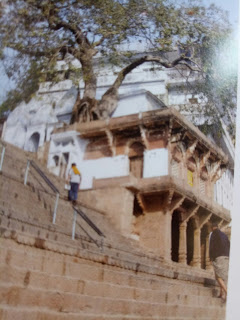
Tulsidas Ashram at Tulsi Ghat  It is five pm and I find myself back on the banks of the river Ganga in Varanasi, as it flows so quietly that it almost appears still. I am on my way to locate a 400 year old house where the Ramcharitmanas was written in Tulsi Ghat, one among the famed ghats of Varanasi. Tulsi Ghat is slightly higher than the rest and a steep staircase, three Shiva shrines, an old peepal tree and a white colour tree with a large balcony mark Tulsi Ghat. A fairly aggressive greets me with aggression as it jumps from the peepal tree. I become defensive and allows me to pass. In Tulsi Ghat, I spot the guesthouse of the Sankatmochan Foundation and the laboratory of the Swachh Ganga Foundation, which spearheads the cleanup of the river Ganga in Varanasi. For a house that is 400 years old, one would expect it to be fairly well-known. I ask for directions to the Tulsi Ashram and a man indicates the house with his index finger right across the street opposite the akhar...
Tulsi Akhara: Fight Club of Varanasi

Image
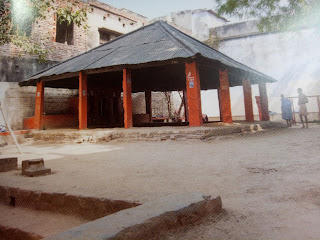
The wrestling rink at Tulsi Akhara  The sun rises gently over the horizon and casts its deep reflections on the river Ganga a few minutes past seven. For many, it is the rise of yet another day in the ancient city of Varanasi. This morning, I am curious to explore the Tulsi Akhara in Tulsi Ghat, Varanasi to observe the morning routine of pehelwans (wrestlers). Nervous and excited, I walk in to the Swaminath Akhara in Tulsi Ghat and I greet Pehelwan Siyaramji with a namaste. He lights an incense stick and places it near the feet of the ochre-coloured idol of Bajrangbali (Hanuman, an ardent devotee of Lord Rama and one of the central characters in the Ramayana). Akharas (wrestling clubs) are the original gymnasiums of India, often to show their wrestling prowess. “A regular day in the akhara begins at six am with dand baithaks (sit-ups) or jori phirna (turning around a pair of wooden cylinders tapering at one end, filled usually with iron or concrete). This is followed by...

Misplaced Contemporary Past:

Image
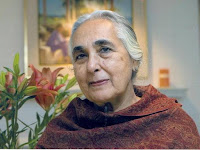
Romila Thapar Pic Courtesy: The Hindu A week ago, ahead of her book launch, the Internet arm of TV channel NDTV published an excerpt from “Indian Cultures As Heritage: Contemporary Pasts” by eminent historian Romila Thapar. In the excerpt, she eloquently articulates about the pressures that have arisen due to political parties claiming to be unhappy with the content being taught in school and college textbooks. This, according to her, paves the way to seek revisions and rewriting of textbooks. Political intrusion, needless to say, must be unanimously condemned, irrespective of our individual and political affiliations. Hence, the aim of this post has been to draw Ms. Thapar’s attention to certain points she makes which deserve to be contested. In the excerpt, she claims that educational institutions are often used by administrators as stepping stones in order to realise personal ambitions, which results in the credibility of an institution taking a backseat. This is certainl...

Statue of Vandalism

The Internet on Tuesday erupted in shock as a statue of Russian communist revolutionary Vladimir Lenin was razed by a group of suspected BJP workers in Belonia, Tripura amidst chants of "Bharat Mata Ki Jai". The demolition comes days after the BJP-led alliance managed to wrest control of the state, which experienced communist rule for the past 25 years. In such a climate, a reaction is often influenced by the ideological and political strand that one subscribes by. The reactions that flooded the Internet soon after the video went viral ranged from shock, misplaced anger to even celebration. The demolition did evoke strong reactions from both sides as the detractors commented that vandalism should not be encouraged and the demolition of a statue by a democratically elected government shows its contempt for erasing history. The supporters, meanwhile, cheered as the razing of the statue which they termed as the symbolic end of a rule characterised by oppression, intimidation ...

Book Review: The Friendless God

Image
The Friiendless God Pic Courtesy: Goodreads  Book: The Friendless God Author: S. Anuradha Publishers: Moonlight Publications Pages: 350 There is little doubt that India is a country of myriad facets, where the ancient co-exists with the modern. "The Friendless God" is S. Anuradha's debut novel. The Singapore based journalist specialises  in equities. Set against the backdrop of the turbulent demolition of the Babri Masjid and the Ram Janmabhoomi in 1992 for the larger premise, the novel interestingly follows the parallel yet overlapping journeys of an atheist single mother Vaidehi, who is also a struggling Carnatic music exponent and her son Kodanda, who tries to befriend Rama, meets with resistance from his mother Vaidehi. In addition, the book follows the life of an orphan Raman, for whom Rama is a tool to scale ahead in life. It is within this framework that "The Friendless God" traces the lives of the three characters and their equations with the ...

Wink of an Eye

The first Internet sensation of 2018 is here: Priya Prakash Varrier. Until last weekend, nobody knew the 18 year old actor from Kerala. In the run up to Valentine's Day on Wednesdsy, promoters of the Malayalam movie "Oru Adaar Love" uploaded a 3:16 minute video of the song " Manikya Malaraya Poovi " on YouTube. In the trailer, we can see Priya Varrier winking at her co-star which instantly catapulted her to what many believe she is the "national Valentine".  The clip features the song "Manikya Malaraya Poovi", with an ensemble cast playing uniformed school kids falling in love in seemingly soft-lit slow motion. Priya Varrier, in a bit that lasts for just 30 seconds, locks gazes with a boy, raises her eyebrows and even winks at him, thus flooring him and seemingly the country as well. On Wednesday evening, popular Hindi channel Aaj Tak fell prey to a parody tweet and aired a full debate around it. The tweet, issued by a parody and sa...

Jignesh Mevani and "that Mic"

Image
Jignesh Mevani Pic Courtesy: Livemint On Thursday, newly elected member Jignesh Mevani from Vadgam in Gujarat opted out of an impromptu reaction on the sidelines of a public meeting in Chennai. The reason? Mevani spotted a Republic TV mic among other microphones on the table. This led to Jignesh Mevani demanding that the Republic TV mic be removed before he addressed the media. Interestingly, the interaction at first glance appeared as a press conference but as clarified by N. Jayaraman on The Wire , that the interaction was after an event, where he was invited by a study circle. The incident led to a boycott of Chennai's media which walked off after saying that a politician cannot dictate terms to the media. The boycott raised an important question about who has or does not have access to a media outfit and under what c ircumstances. The refusal to engage with a Republic TV led to a stormy debate among journalists. Rationally speaking, both sides of the debate have a valid...

Citizen Goswami

Amidst the fireworks which were burnt during the Deepavali week, the nation received a bombshell. The editor-in-chief of Times Now and ET Now Arnab Goswami announced his decision of quitting the Times Group to start his own venture. The bombshell in the literal sense led to shock across newsrooms even as Twitter and social media went into a tizzy trying to speculate the reasons for quitting and wondering what next for the fiery anchor. For some, the exit from Times Now also spelled relief since he is seen as the key anchor responsible for oversimplification of TV debates. The nation wondered whether if Arnab’s blazing guns will silent and whether if there will be no more noise at 9 pm. It was as if viewers had been orphaned at a crucial moment and we were left to fend for ourselves to find alternative sources of entertainment to keep ourselves entertained at 9 pm. There is little doubt about the severe credibility crisis that most journalists in India face today. Most journalists...

Karva Chauth: Regression vs Choice

It is finally that time of the year when social media goes into a tizzy as women often accuse each other of being shrill ‘feminists’ or declare themselves as slaves to patriarchy. Today is Karva Chauth, a festival where married women observe a fast for a day to pray for the long life of their husbands. While routine one day fasts must not create so much of a problem, it is rare for anyone to come across chatter on social media and websites which seek to promote ‘independent’ opinions on how Karva Chauth is ‘patriarchal and repressive’. Observing the fast or not, must remain an individual choice. The relationship she shares with her husband will dictate her choice to abide by tradition or break free from it. With much chatter being generated online on the patriarchal and repressive aspect of the festival, it does not take much time to realise the anguish that some women go through for choosing to observe the fast. We are subjected to discourses on free speech, independent choices...

The Big Talk:

Much commentary, often bordering near speculation, had been dedicated to a pattern of loose talk which rotated in a circular manner of ‘will he, won’t he’ guesswork. Raghuram Rajan announced an end to needless speculation by expressing his desire to return to academia after his responsibility as India’s central banker comes to an end. While his decision shocked many and with certain sections of media behaving as if we had been sucked into an apocalypse, the government finally announced that it was Urjit Patel who would succeed Rajan. There is no doubt that Raghuram Rajan’s proximity to the media led to the creation of an invisible halo around him. One often wonders whether if a routine exercise such as the appointment of India’s central banker would have triggered so much speculation and interest. Surely, there is no denying that Raghuram Rajan’s frequent media appearances, widely covered lectures and a highly relatable personality often led to a debate whether if he has succeede...

Kinder Ploy

Image
Kinder Joy: Everyday Sexism, anyone?  I recently signed up for a short course on children’s literature. In one of the course modules, the facilitator asked us to ruminate on the constructions of childhood through images in recent times. Interestingly, one of the images I found was this picture of Kinder Joy, a popular chocolate based snack for kids by Ferrero which among other things makes things like Nutella, Tic Tac mouth fresheners etc. The colours in which the egg-shaped chocolate snack appears is part of a larger malaise. The egg-shaped snack appears in two distinct colours: blue and pink and yet, it is one of the most popular chocolate based snacks due to the plastic toys that come along with it. The blue eggs are for boys and have ‘brave’ toys like an aircraft while the pink eggs for girls have ‘domestic’ toys like doll accessories. With the kind of toys Kinder Joy offers, it baffles me about the exact ways these toys are considered ‘suitable’ for boys and girls. B...

How Blue is my Sapphire

‘I am late, I am late. Excuse me, please give me way, I’m late,’ I murmured while running for my life. ‘I am really late,’ I kept murmuring as I kept pushing against people, trying to find space to board the Howrah Mail. I boarded my coach, on time even as the engine gave a sharp hoot indicating departure. I noticed the time on my watch 22:00 pm sharp. The summer vacations were coming to an end and I was returning to Mumbai. I occupied my seat and I plugged in my headphones to drown out the noise and pretended to sleep in the upper berth. I woke up the next morning when the train reached Mughalsarai. My co-passenger was reading a newspaper while I was reading ‘The Overcoat’ by Nikolai Gogol. When the train reached Manikpur, a book seller boarded the coach and I was overjoyed. It was a pleasure to browse through his collection. I tried my hand at attempting small-talk. ‘Manohar,’ he announced his name. Finishing his evening tea, Manohar flung the paper cup out of the window with a...

Mumbai Untravelled: Banganga Tank

Image
God with wives from across caste lines, a temple aided by Muslims, a burial ground for Hindu ascetics and a fresh water tank surrounded by the sea in Mumbai, sounds impossible? Welcome to Banganga, one of the oldest continuously inhabited neighbourhoods of Mumbai.  During the 30 minute ride from Mumbai CST to Walkeshwar Depot, I kept wondering about the origin of Malabar Hill. At the depot, I recounted an earlier conversation with a conservation architect, who explained that the hills that mark the area, are not known so because they have anything to do with the Malabar region of Kerala. Devotees from the south of Konkan would visit the Banganga and in those days, anyone coming from the south was known as a Malabari.   As I landed at the Walkeshwar Depot and looked around, I was prepared to be surprised. The beginning of the walk at Banganga led me to initially believe that it was a walk for the spiritually inclined. While it does help if you lean towards history, my...

Hawa Mahal: A Natural Cooling System

Image
The Hawa Mahal A strong wind blows, stops at the closed windows in mock surprise. It then rushes through the tiny orifices, quietly rising through the narrow spiral staircases and stopping at the other side. The cylindrical balconies now appear stacked upon one another, like a set of different-sized flutes when tied together. From the chaotic crossroads at Badi Choupad in Jaipur, the road slopes down as it goes past the Old Legislative Assembly and Town Hall and the Hawa Mahal appears on the left, in a self-repeating fractal pattern spanning five floors in a series of smaller pyramids.  The Hawa Mahal in its fundamental design resembles a honeycomb structure. It has also been equated as a symbolic representation of Lord Krishna’s crown. The Hawa Mahal was designed by architect Lal Chand Ustad for Maharaj Sawai Pratap Singh.  The original function of the building was to allow women watch processions on the streets below, through the intricate jharokhas, without a thre...

Counter Narratives: Murty Classical Library of India

In a finely written opinion piece , Ananya Vajpeyi from the Centre for Developing Studies in New Delhi, argues that online opposition demanding Professor Sheldon Pollock’s dismissal as the mentor of the Murty Classical Library of India (MCLI) is based on mere ‘right-wing propaganda’. In this article, I take objection to the term ‘right-wing propaganda’. Social media has taught us that anyone who challenges an intellectual by arguing on facts is sidelined and labelled for furthering a ‘saffron’ agenda. While arguing for Professor Pollock’s retention, Ms. Vajpeyi passes a value judgment of the 132 principal sponsors of the online petition by denouncing them for ‘not having the knowledge of Sanskrit and other classical languages, literature, history or the humanities.’ The stand chosen by her is not surprising given that she defends Professor Pollock because she was his doctoral student. Therefore, anyone who criticises an eminent personality is deficient in understanding and therefor...

Savitri

The vacations were coming to an end. Savitri finally felt a sense of fulfillment and she was pleased with herself. Her application as a lecturer at S.V. College had been accepted and she was radiant. Her six years of hard work: balancing home and her work had paid off very well. She had worked hard to secure her postgraduate degree in Economics with the help of a scholarship. ‘My father is coming to spend his time with Vivek,’ she announced with a sense of pride. Her husband Harish was not very happy to hear this but still smiled. He was the district collector. Though he had his reservations about her job, he supported his wife. She was going to be teaching at the same Economics department where she was once a student, seven years ago. Savitri’s father Devdutt arrived by the train early morning on Sunday. She hugged him and prostrated at his feet when he along with Harish reached home in the car. Savitri left early for college on Monday as she had to submit her project report....