Posts

Showing posts with the label Indiadhanush

Discovering Tulsidas in Tulsi Ghat
Image
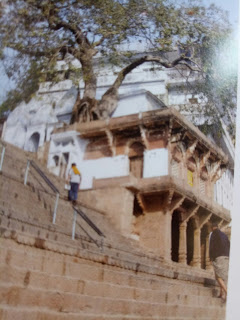
Tulsidas Ashram at Tulsi Ghat  It is five pm and I find myself back on the banks of the river Ganga in Varanasi, as it flows so quietly that it almost appears still. I am on my way to locate a 400 year old house where the Ramcharitmanas was written in Tulsi Ghat, one among the famed ghats of Varanasi. Tulsi Ghat is slightly higher than the rest and a steep staircase, three Shiva shrines, an old peepal tree and a white colour tree with a large balcony mark Tulsi Ghat. A fairly aggressive greets me with aggression as it jumps from the peepal tree. I become defensive and allows me to pass. In Tulsi Ghat, I spot the guesthouse of the Sankatmochan Foundation and the laboratory of the Swachh Ganga Foundation, which spearheads the cleanup of the river Ganga in Varanasi. For a house that is 400 years old, one would expect it to be fairly well-known. I ask for directions to the Tulsi Ashram and a man indicates the house with his index finger right across the street opposite the akhar...
Tulsi Akhara: Fight Club of Varanasi

Image
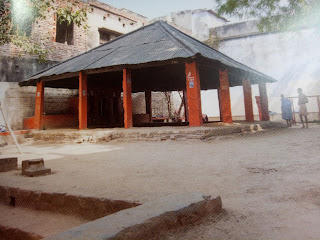
The wrestling rink at Tulsi Akhara  The sun rises gently over the horizon and casts its deep reflections on the river Ganga a few minutes past seven. For many, it is the rise of yet another day in the ancient city of Varanasi. This morning, I am curious to explore the Tulsi Akhara in Tulsi Ghat, Varanasi to observe the morning routine of pehelwans (wrestlers). Nervous and excited, I walk in to the Swaminath Akhara in Tulsi Ghat and I greet Pehelwan Siyaramji with a namaste. He lights an incense stick and places it near the feet of the ochre-coloured idol of Bajrangbali (Hanuman, an ardent devotee of Lord Rama and one of the central characters in the Ramayana). Akharas (wrestling clubs) are the original gymnasiums of India, often to show their wrestling prowess. “A regular day in the akhara begins at six am with dand baithaks (sit-ups) or jori phirna (turning around a pair of wooden cylinders tapering at one end, filled usually with iron or concrete). This is followed by...

Mumbai Untravelled: Banganga Tank

Image
God with wives from across caste lines, a temple aided by Muslims, a burial ground for Hindu ascetics and a fresh water tank surrounded by the sea in Mumbai, sounds impossible? Welcome to Banganga, one of the oldest continuously inhabited neighbourhoods of Mumbai.  During the 30 minute ride from Mumbai CST to Walkeshwar Depot, I kept wondering about the origin of Malabar Hill. At the depot, I recounted an earlier conversation with a conservation architect, who explained that the hills that mark the area, are not known so because they have anything to do with the Malabar region of Kerala. Devotees from the south of Konkan would visit the Banganga and in those days, anyone coming from the south was known as a Malabari.   As I landed at the Walkeshwar Depot and looked around, I was prepared to be surprised. The beginning of the walk at Banganga led me to initially believe that it was a walk for the spiritually inclined. While it does help if you lean towards history, my...

Hawa Mahal: A Natural Cooling System

Image
The Hawa Mahal A strong wind blows, stops at the closed windows in mock surprise. It then rushes through the tiny orifices, quietly rising through the narrow spiral staircases and stopping at the other side. The cylindrical balconies now appear stacked upon one another, like a set of different-sized flutes when tied together. From the chaotic crossroads at Badi Choupad in Jaipur, the road slopes down as it goes past the Old Legislative Assembly and Town Hall and the Hawa Mahal appears on the left, in a self-repeating fractal pattern spanning five floors in a series of smaller pyramids.  The Hawa Mahal in its fundamental design resembles a honeycomb structure. It has also been equated as a symbolic representation of Lord Krishna’s crown. The Hawa Mahal was designed by architect Lal Chand Ustad for Maharaj Sawai Pratap Singh.  The original function of the building was to allow women watch processions on the streets below, through the intricate jharokhas, without a thre...

Zero Miles: Centre of India

Image
Picture Courtesy: Google Images Nestled in a tiny corner southeast of the Vidhan Bhavan and the RBI Square of Nagpur, is literally located the centre of India. The Zero Milestone is a sandstone pillar and has four horses beside it. The four horses denote the four cardinal directions. The passion for surveying and cartography by the British led to many cities having zero stones. However, the zero milestone of Nagpur is unique because it marks the geographical centre of India. Erected by the British as the central point to measure distances to all major cities, the zero milestone is a significant but often overlooked part of Nagpur.  When India was divided into provinces, Nagpur was the erstwhile capital of the Central Provinces and Berar Provinces. The Central Provinces and Berar was together made up of 22 districts, which were grouped in five divisions. The divisions of the Central Provinces were classified as Jabalpur, Narmada, Nagpur, Chhattisgarh and the Berar division. T...

Anthropology Museum

Image
One of the most interesting topics in social sciences has been the study of humans, past and present. Anthropology is the field which works within the field of social and biological sciences along with the humanities and physical sciences. The evolution of the human race worldwide has been an important area of research which seeks to explore the physical and cultural development, biological characteristics and social customs and beliefs of the people which concern the long-term development of the human race. Image Courtesy: Rajendra Joshi The Zonal Anthropological Museum, opposite the Balaji Temple at Seminary Hills in Nagpur, is run by the Anthropological Survey of India. It is an attempt to showcase human evolution, adaptation and bio-cultural diversity with special reference to the central region of India and its large number of ethnic groups and their rich cultural heritage. The museum has about 2300 specimens from tribes and other communities inhabiting Madhya Pradesh, C...

Sakthan Thampuran Palace:

Image
Sakthan Thampuran Palace, Thrissur The town that is, Thrissur owes much of its rich legacy as a tourist destination to its architect, Sakthan Thampuran. Situated close to the legendary Vadakkumnathan Shiva Temple, opposite the Northern Bus Stand and a short walk from the railway station, lies the recently renovated Sakthan Thampuran Palace. For those who are unfamiliar with Kerala, the short span of 15 years from 1790 to 1805 under the rule of Maharaja Rama Varma Sakthan Thampuran is considered as the golden era of Cochin and its royal family. His foresight, outstanding administrative skills and smart diplomacy, earned him accolades for spearheading achievements in key sectors. In his lifetime, the ruler is reported to have maintained cordial with European powers such as the British and also with rulers of neighbouring kingdoms, such as the Samoothiri kings of Kozhikode, the rulers of Mysore and Travancore. Within the palace, there are adequate references alluded to the rulers o...

Ayurveda Museum

Image
That's me at the entrance of the museum   On a not so busy tarred road, three kilometres from Ollur railway station in Thrissur district, lies a tiny village: Thaikattussery. As the unrelenting April sun seems determined to drain you, coconut groves and paddy fields which grow nearby rush to your rescue by offering to neutralise the heat. A well-planned wooden gate, opposite the Vaidyaratnam Corporate office, allows one to spot a statue of Jagadguru Sri. Adi Sankaracharya seated on a granite slab with a Sanskrit shloka inscribed below it. The Vaidyaratnam Ayurveda Museum, established by the Ashtavaidyan Thaikattu Mooss’ Vaidyaratnam Group of Institutions is the first museum in India dedicated to promoting health tourism. Regarded as an upaveda (subsidiary), the knowledge of Ayurveda is firmly rooted in the millennia old Vedic knowledge systems. Hence, Ayurveda is the oldest form of healthcare in the world. Simply put, Ayurveda means the science of life which by itself is...

Tripunithura Hill Palace

Image
The Palace By The Road: Tripunithura Hill Palace I was introduced to the Tripunithura Hill Palace through the 1993 Malayalam blockbuster 'Manichitrathazhu' that was shot in the palace premises. This was in late 2008. I believe that for many the introduction to the palace was through the movie. My feet contacted the mud at the Hill Palace only in May 2009 during a cousin's wedding in Ernakulam. I happened to revisit the palace accidentally in February 2014 during an industrial visit to Kottayam and Cochin. Visiting the Hill Palace after nearly five years brought back vivid memories from the movie and my first visit here. The nrityathi with the lamp In the little town of Tripunithura, an extended suburb of Ernakulam, is located the erstwhile residence of the Maharaja of Cochin. The palace is named so because of its location on a tiny hillock at a slight incline from the main road. The uphill climb to the palace is almost like climbing a staircase in a park. As one ...

Myth vs Science: The Curse of Talakkad

Image
The Arakeswara Temple, Talakkad A pleasant breeze welcomes you along with a prolonged silence, an unnerving silence that one can hear the click and clack sounds of one’s footsteps. The little temple town of Talakkad, situated on the left banks of the river Kaveri, located nearly 60 kms from Mysore, is famed for its constantly in motion sand dunes. In desolate towns like Talakkad, the mysteries unravel as one goes around exploring the place. Yet, it seems like there is an imposition on how much one should know. The temple town is mostly known for a legendary curse which turned the thriving town into a sandy shore line. Hence, it is a treat for anyone who has a passion for history, heritage or architecture. History and rationality clash with mythology here in the town which is also known as Dalavanapura and Gajaranya. Local myths speak of Lord Shiva residing on a tree that was later worshipped by locals and saints. The tree is said to have then reincarnated as an elephant, givi...

Shweta Varahaswamy Temple

Image
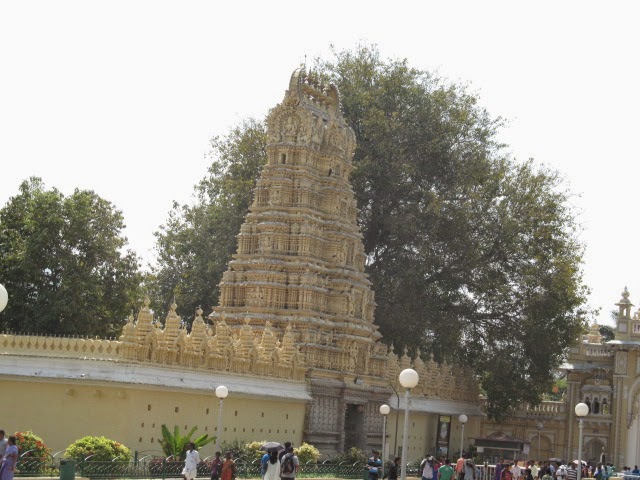
Shweta Varahaswamy Temple, Mysore As I entered the Mysore Palace through the Varaha Gate, I wondered why the gate was named so. A short scan in and around the palace premises led me to spotting the yellow gopuram of the Shweta Varahaswamy Temple. Located at the southern entrance of the Mysore Palace, the gate gets its name from the temple. It is one of the temples located inside the Palace that the Wodeyar kings of Mysore have patronised over the years.  There are very few temples dedicated to Varaha, the third incarnation of Lord Vishnu in India and Mysore's Varahaswamy Temple is among them. Every incarnation of the Dasavatharam has a significance of its own: the Varaha avataram is associated with pellucid knowledge which is attuned to knowledge. In a Tamil poem written by Andal, she fondly sings of Varaha as: 'the shameless boar with sweat pouring out from its dusty body'. The tale of Varaha observes that Hiranyaksha hid the Earth in the Rasatala regions, one of ...

Regional Railway Museum, Mysore

Image
In Mysore lies a modestly planned railway museum located opposite the Central Food Technical Research Institute on the busy Krishnaraja Sagara Road. The cheap tickets that enable access to the museum are sold from the window of a former vacuum braked railway compartment, offering a fascinating glimpse into a bygone era. Presenting an interesting slice of history that spans across 160 years, the railway museum should be a must visit if you wish to familiarise yourself with one of the finest modes for national integration: Indian Railways.  Metre Gauge Diesel Engine from Krishnarajapuram Set up under the supervision of the Indian Railways, the museum was inaugurated by Srikantadatta Narasimharaja Wodeyar, the last descendant of Mysore's Wodeyar dynasty in June 1979. With an indoor and outdoor section, the museum has ancient steam locomotives, condemned metre gauge diesel engines, carriages, wagons, telecommunication equipment and several other paraphernalia that have in some ...