Posts

Showing posts with the label Tulsi Ghat

Discovering Tulsidas in Tulsi Ghat
Image
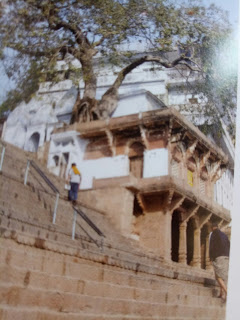
Tulsidas Ashram at Tulsi Ghat  It is five pm and I find myself back on the banks of the river Ganga in Varanasi, as it flows so quietly that it almost appears still. I am on my way to locate a 400 year old house where the Ramcharitmanas was written in Tulsi Ghat, one among the famed ghats of Varanasi. Tulsi Ghat is slightly higher than the rest and a steep staircase, three Shiva shrines, an old peepal tree and a white colour tree with a large balcony mark Tulsi Ghat. A fairly aggressive greets me with aggression as it jumps from the peepal tree. I become defensive and allows me to pass. In Tulsi Ghat, I spot the guesthouse of the Sankatmochan Foundation and the laboratory of the Swachh Ganga Foundation, which spearheads the cleanup of the river Ganga in Varanasi. For a house that is 400 years old, one would expect it to be fairly well-known. I ask for directions to the Tulsi Ashram and a man indicates the house with his index finger right across the street opposite the akhar...
Tulsi Akhara: Fight Club of Varanasi

Image
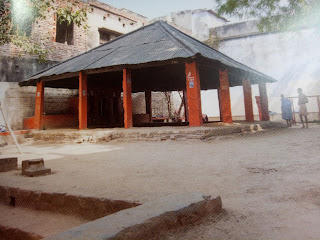
The wrestling rink at Tulsi Akhara  The sun rises gently over the horizon and casts its deep reflections on the river Ganga a few minutes past seven. For many, it is the rise of yet another day in the ancient city of Varanasi. This morning, I am curious to explore the Tulsi Akhara in Tulsi Ghat, Varanasi to observe the morning routine of pehelwans (wrestlers). Nervous and excited, I walk in to the Swaminath Akhara in Tulsi Ghat and I greet Pehelwan Siyaramji with a namaste. He lights an incense stick and places it near the feet of the ochre-coloured idol of Bajrangbali (Hanuman, an ardent devotee of Lord Rama and one of the central characters in the Ramayana). Akharas (wrestling clubs) are the original gymnasiums of India, often to show their wrestling prowess. “A regular day in the akhara begins at six am with dand baithaks (sit-ups) or jori phirna (turning around a pair of wooden cylinders tapering at one end, filled usually with iron or concrete). This is followed by...