Posts

Jaganmohan Palace

Image
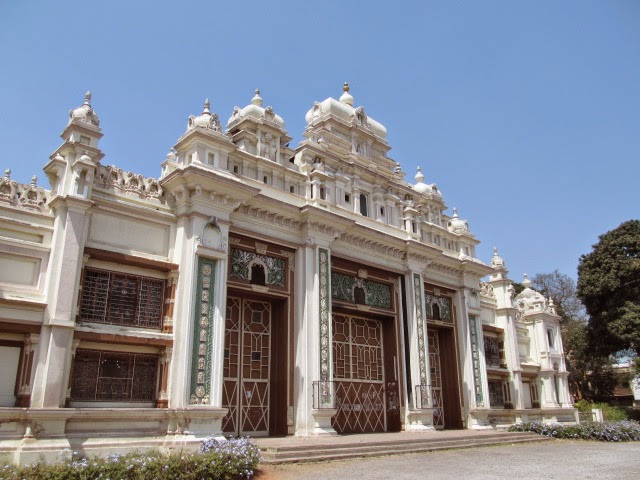
The Palace Gate: Jaganmohan Palace In Mysore, one is never too far from royalty. Located west of the illustrious Mysore Palace, the Jaganmohan Palace is one of the seven palaces that the Wodeyar kings built in and around the city, making it a true recipient of the royal legacy. Within the main city itself, there are seven such palaces. As one enters the Jayachamarajendra Art Gallery, located inside the palace, one is greeted with a striking masterpiece adorned with intricate carvings that have been carved in a short span of just 70 days. Venturing deeper, one finds wooden doors that narrate the tale of Dasavatharam , the ten incarnations of Lord Vishnu. The Jaganmohan Palace was built during the reign of Krishnaraja Wodeyar-III and was completed in 1861. Since the main Ambavilas Palace, widely familiar as the Mysore Palace was burnt down in a fire, the Jaganmohan Palace was commissioned to serve as the residence of the royal family until 1912, the year when the Mysore Palace...

Brindavan Gardens

Image
Amidst the spectacle of the setting sun, a cool breeze wafts in as one gets past the gates of Brindavan Gardens in Mysore, leading one to spot the imposing the Krishnaraja Sagara Dam, fondly known as the KRS Dam, built across the river Kaveri. With an imposing height of 8600 feet and a height of 130 feet above the river, the Krishnaraja Sagara Dam stands tall at the confluence of three rivers: Kaveri, Hemavati and Lakshmanateertha since 1924. Named after Maharaja Krishnaraja Wodeyar-IV, who ruled Mysore from 1894 until his death in 1940, the dam was built by India's best known engineer, Sir M. Visweswaraya, then the chief engineer of Mysore, using ' surkhi' , a mixture of limestone and brick powder instead of cement. Operational since 1924, the KRS Dam is one of the earliest dams in the world to use automatic sluice gates. The Krishnaraja Sagara Dam is an outstanding example of civil engineering and the Brindavan Gardens below it is a major crowd-puller.  The statue o...

Mysore Chamundeshwari Temple

Image
The main entrance of the Chamundi Temple, Mysore As one gently walks towards the main entrance of the Devi Chamundeshwari temple, located atop Mysore's Chamundi Hills, one is greeted with the chants of the Sanskrit hymn, 'Mahishasuramardhini Stotram', which glorifies the victory of Goddess Chamundeshwari, the slayer of demon Mahishasura. Not surprisingly, for a city that derives its name from the demon, Devi Chamundeshwari is worshipped as the custodian of Mysore and is also the tutelary deity of the Maharajas of Mysore: the Wodeyars. Mahishasura, the demon who lends the city its name With a rich Puranic background, Devi Chamundeshwari is the main subject of the Devi Mahatmyam, which describes the victory of Goddess Durga against Mahishasura. Locals here narrate legends that Mahishasura stayed atop these very hills. The slaying of the demon after an intense nine day war which is recreated through Navratri, results in the hillock gaining its name. The temple ...

Modi Sir Ki Paathshala

The afternoon of September 5, 2014 witnessed a landmark event: the Prime Minister's address to students across the country. The innovative experiment was largely seen as a success considering it was the first time a Prime Minister had taken a proactive step to engage with students and the masses through spontaneous speech which emphasised on the role and importance of teachers and their role in strengthening the nation as much as the exercise was aimed to engage with citizens to enroll themselves in the democratic discourse. Children and youth are a valuable asset as the workforce is determined by the talent and knowledge pool of a country. In 1930, shortly after the celebrated Dandi March, Mahatma Gandhi had said that youth are leaders of tomorrow and it is the young who have to be the salt of the nation. If salt loses its flavour, where shall it be salted? An exercise like the Teachers' Day address will go a long way in making students an important part of the nation build...

Modi at 100: Not Out

The concept of "100 Days" was initiated in the United States of America when its President Delano Roosevelt borrowed the term "100 Days" from Napoleonic history to describe the workings of the 73rd US Congress which sat for 100 days from March 9, 1933 to June 17, 1933. Thus, the term came first to be used in a radio address on July 24 that same year. At this juncture, please note that 100 days does not refer to the then US President's tenure but the session of the Congress.  Since then, 100 days has become an indicator of performance for all US Presidents and is now also being applied to an Indian Prime Minister. A period of 100 days in power is too short for anybody: more so, the Prime Minister of a country especially when Narendra Modi has sought five years to show some results in critical areas like power and the Ganga Clean Up project and ten years, in some areas like infrastructure. While I strongly believe that 100 days is too less a time for announcing...

RIP, Planning Commission!

In his maiden address to the nation on Independence Day, the Prime Minister Narendra Modi announced that the Planning Commission would meet its end and will promptly be replaced by a policy research think-tank which will be constituted of eminent luminaries in their respective fields. The abolition of the Planning Commission, is a bold step by the government, as it is one of the most important signals which indicate changing priorities as the narrative structure shifts from left-of-centre to a centre-right perspective. The Planning Commission is largely seen as a Nehruvian socialist regime and hence, the end of the Commission is a symbolic gesture to highlight the generational change within the country's polity. While the media-driven public opinion was certainly that the Planning Commission is an ultimate example for policy paralysis, the reality is different from what the narration says. It is important to clarify that the idea of the new government is not to deride or demolis...

Movie Review: Rama Madhav

Image
रमा माधव: नितांत सुंदर प्रेम कहाणी The 2014 Marathi film "Rama Madhav" by actress-filmmaker Mrinal Kulkarni explores the era of the Peshwa period and particularly from the angles of women. The film is an interesting take on life of Peshwa through a young girl's eyes. The film begins with a 12 year old Rama hailing from a middle-class background in Miraj and being married to the Peshwa prince, Madhavrao during her childhood. The film is a royal love story and it is set against the backdrop of politics, war and the rise of a new era.  The film follows the life and coming-of-age Rama and as they grow older, the political scenario changes with the Marathas losing to Ahmedshah Abdali, the Afghan prince in the Third Battle of Panipat in 1761, their scheming uncle Raghunathrao who plots Madhavrao's death on not being selected as the heir for the Peshwa throne and the subsequent arrival of the British.  Shot extensively on sets resembling the Shaniwarwada of Pune, the ...